Why RAG Matters
Foundation models know a lot about the world, but they know nothing about your organization. They do not know your products, policies, customer history, or internal procedures. Retrieval-Augmented Generation (RAG) bridges this gap by retrieving relevant information from your knowledge base and providing it to the model as context.
The result: AI that answers questions, generates content, and makes decisions based on your organization's actual data — not generic training data.
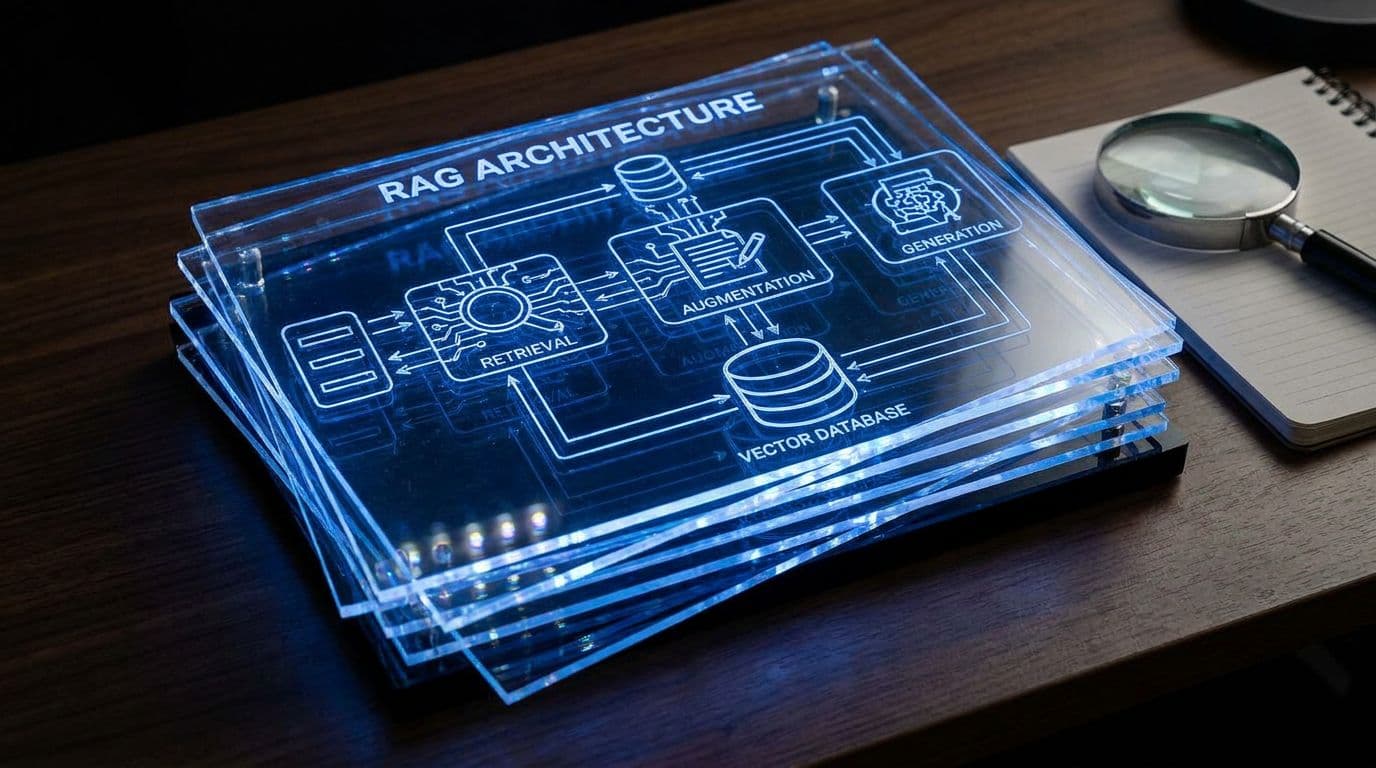
RAG Architecture
A production RAG system has four components:
1. Document Processing Pipeline
Raw documents (PDFs, web pages, databases, wikis) must be processed into a format suitable for retrieval:
- Extraction: Convert documents to text, handling tables, images, and formatting.
- Chunking: Split documents into semantically meaningful chunks. Chunk size matters — too large reduces retrieval precision, too small loses context.
- Metadata enrichment: Tag chunks with source, date, author, document type, and other metadata that aids filtering.
2. Embedding and Indexing
Chunks are converted to vector embeddings (numerical representations that capture semantic meaning) and stored in a vector database:
- Embedding models: OpenAI text-embedding-3-large, Cohere embed-v3, or open-source alternatives.
- Vector databases: Supabase pgvector, Pinecone, Weaviate, or Qdrant.
- Hybrid indexing: Combine vector search with keyword search (BM25) for better retrieval.
3. Retrieval
When a query arrives, the system retrieves the most relevant chunks:
- Semantic search: Find chunks whose embeddings are closest to the query embedding.
- Filtering: Apply metadata filters (date range, document type, department) to narrow results.
- Re-ranking: Use a cross-encoder model to re-rank retrieved chunks by relevance to the specific query.
- Deduplication: Remove redundant information from different sources.
4. Generation
Retrieved chunks are provided to the language model as context:
- Prompt construction: System prompt + retrieved context + user query.
- Citation: The model should cite which sources it used for each claim.
- Confidence signaling: When retrieved context does not answer the question, the model should say so rather than hallucinate.
Chunking Strategies
Chunking is the most impactful design decision in RAG:
- Fixed-size: Split by token count (e.g., 512 tokens). Simple but may break mid-sentence.
- Semantic: Split at paragraph or section boundaries. Preserves meaning but creates variable-size chunks.
- Recursive: Start with large chunks and recursively split until below a size threshold.
- Agentic: Use an AI model to identify natural breakpoints based on content.
For most enterprise use cases, semantic chunking with 256-512 token chunks and 50-token overlap provides the best balance.
Evaluation
RAG systems require evaluation at two levels:
Retrieval quality: Are the right chunks being retrieved? Measure using:
- Recall@K: How often is the relevant chunk in the top K results?
- MRR: How high does the relevant chunk rank?
Generation quality: Is the final answer correct and grounded? Measure using:
- Faithfulness: Does the answer accurately reflect the retrieved context?
- Relevance: Does the answer address the question?
- Groundedness: Is every claim supported by a cited source?
Common Pitfalls
- Chunking too aggressively: Tiny chunks lose context. If a question requires understanding across multiple paragraphs, small chunks will fail.
- Ignoring metadata: Without metadata filtering, the system retrieves plausible but irrelevant information (outdated policies, wrong department).
- No re-ranking: Vector similarity alone is insufficient. Re-ranking with a cross-encoder dramatically improves precision.
- Static knowledge base: Documents change. Build pipelines that detect and re-process updated documents.
uflo.ai uses RAG extensively across our portfolio platforms and consulting engagements. Contact us for RAG architecture guidance.